
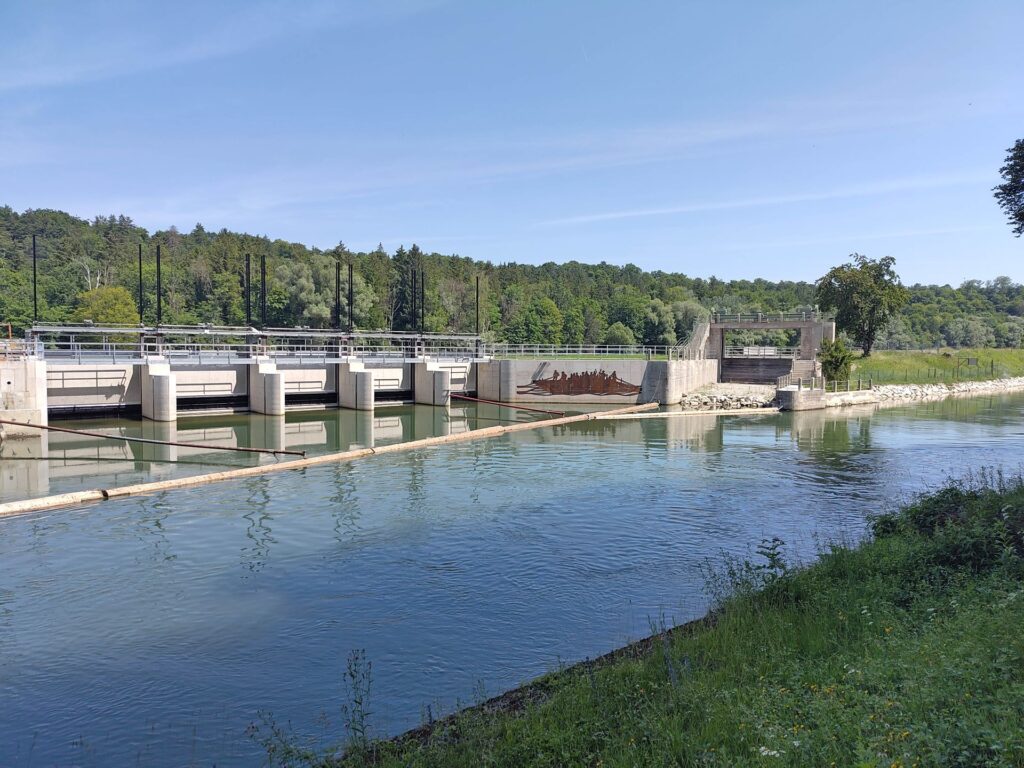
The Großhesseloher weir complex is a listed structure in the south of the Bavarian capital, Munich, and regulates the flow of the River Isar near Pullach. In May, just over two years ago, work began on its refurbishment. Stadtwerke München GmbH (SWM) ensured an optimal refit and update to benefit both the environment and guarantee flood prevention. The facility will soon be 120 years old, and modernisation involved the construction of three new weir sections, a fish ladder and a new weir to separate the River Isar from the service canal. The individual design of the weir sections was of particular technical interest, each being fitted with a conventional weir flap, an air-operated flap gate and a weir sill. However, project implementation proved to be challenging for a number of reasons.
© SWM
Großhesseloher Weir refurbishment improves flood protection and fish migration
Since the Großhesseloher weir in Pullach began operation in 1908 it has regulated the flow of water between the plant canal and the River Isar, as a key means of flood prevention for Munich and served as a supply source for many of the city’s streams. The weir complex is also significant from an energy perspective, as the Werkkanal accommodates four hydroelectric power plants, and the ‘Energiestandort Süd’ site – which generates electricity, district heating and cooling. The plant has a unique ownership structure that has evolved over time. While the City of Munich is responsible for the eastern section of the weir, SWM – an independent company – is responsible for the western section, including the adjustable weir gates that control water flow along the Isar, in the canal and through the fish ladder.
© Pfaffinger
Long-planned refurbishment of the historic Großhesseloher Weir
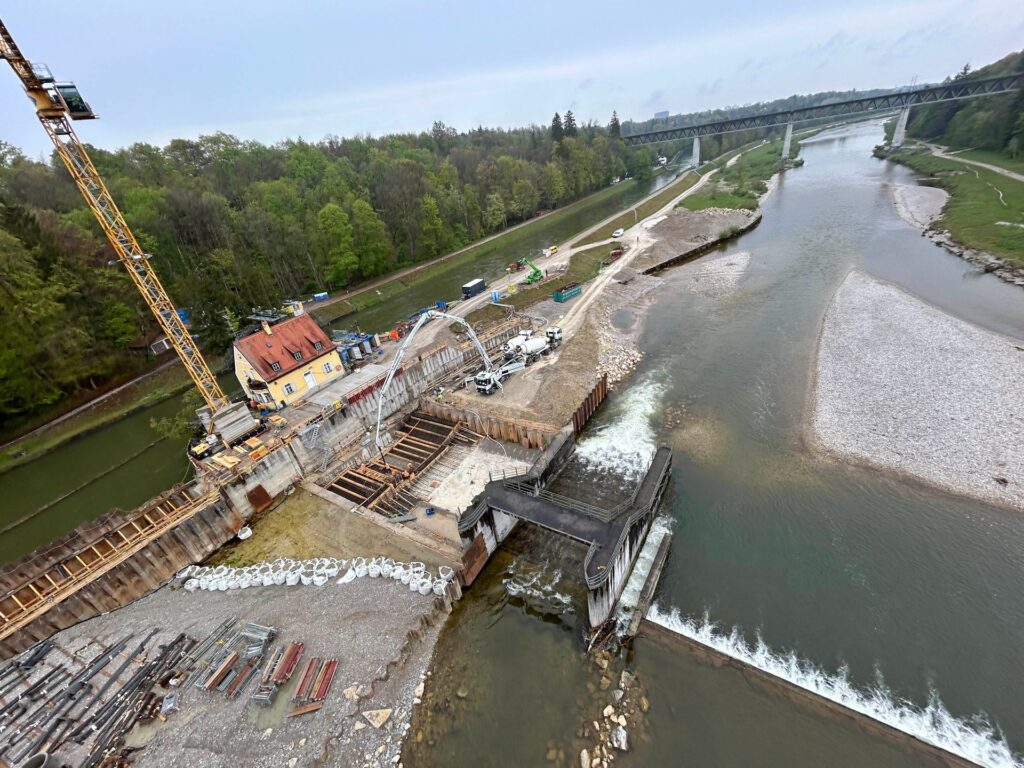
The advanced age of the original technology meant that refurbishment and renewal of the facility had been on the cards for many years, as SWM project manager – Lukas Mas-Zehetbauer explains: “The original decision to renew the weir was taken in 2008 by SWM and the City of Munich, a key point in the agreement being that work should restore the fish passage at the site. A fish ladder had been built into the old weir, but fell far short of the requirements of a modern fish passage facility. Another important issue was the optimisation of debris management at the weir. Renaturation projects conducted over the past decades had significantly increased the volume of debris carried by the Isar. Previously, removal of debris at the weir had been from the middle of the river, presenting a constant problem that we aimed to resolve permanently via renewal.” The initial planning permission application for the replacement structure was finally submitted in 2015. However, the plans as they stood did not comply with the requisite nature conservation specifications, meaning approval could not be provided. Consequently, the project was subjected to a fundamental revision to ensure alignment with official demands – and was ultimately resubmitted for approval in 2021. During the redesigning phase the weir structure was examined and hydraulically optimised with a significantly improved, more compact structure via 3D simulation. The rocky ramp originally envisaged in the plans consisted of coarse riverbed stones that would have been harder for fish to locate – and would also have covered many of the ecologically valuable hydrodynamic scour cavities (flow-induced riverbed erosion holes). Unexpectedly, in 2022 an already sealed-off kayaking and rafting channel was saved from demolition, preserved and renovated. The weir complex had originally been constructed from rammed concrete, and consequently now qualified as a listed historic monument. This necessitated even more changes to the plans. The key features in the landscape at the site were preserved, along with the kayaking channel and the adjacent lock keeper’s house. Of course, it was important not to overlook the safety of recreational sports enthusiasts on the Isar who use inflatable boats and kayaks during the summer months. Several warning signs, buoys, a barrier and a warning beam have now been installed to ensure they disembark before they reach weir.
© Pfaffinger
Modern weir technology combines steel gate, flap gate and fixed sill
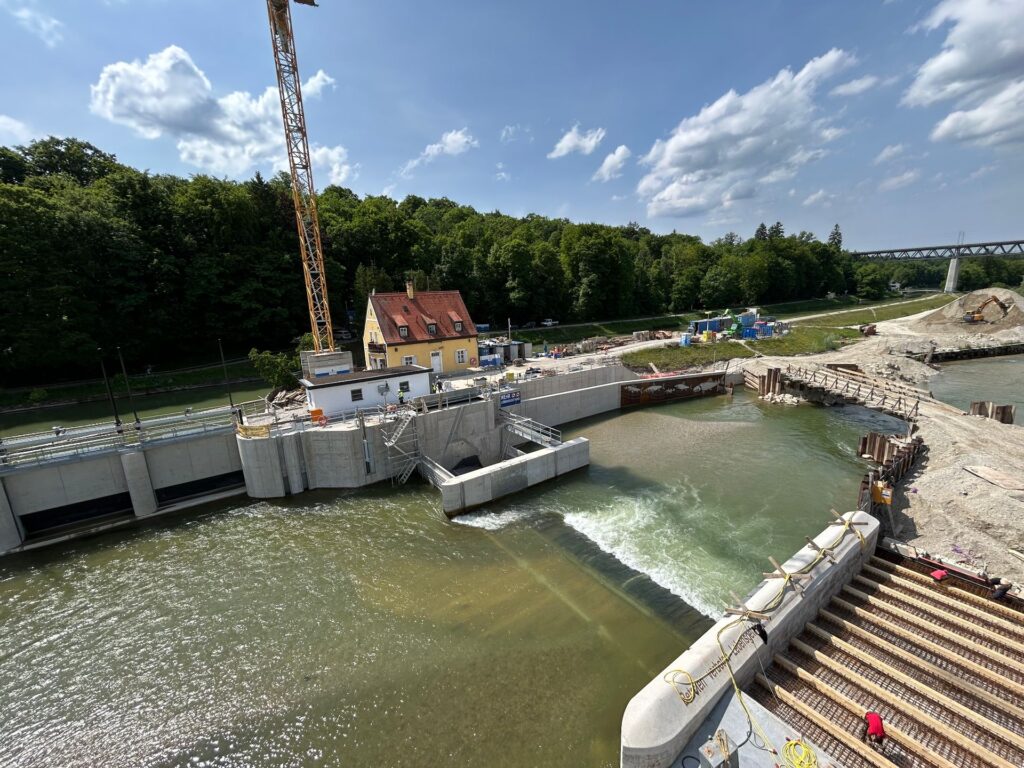
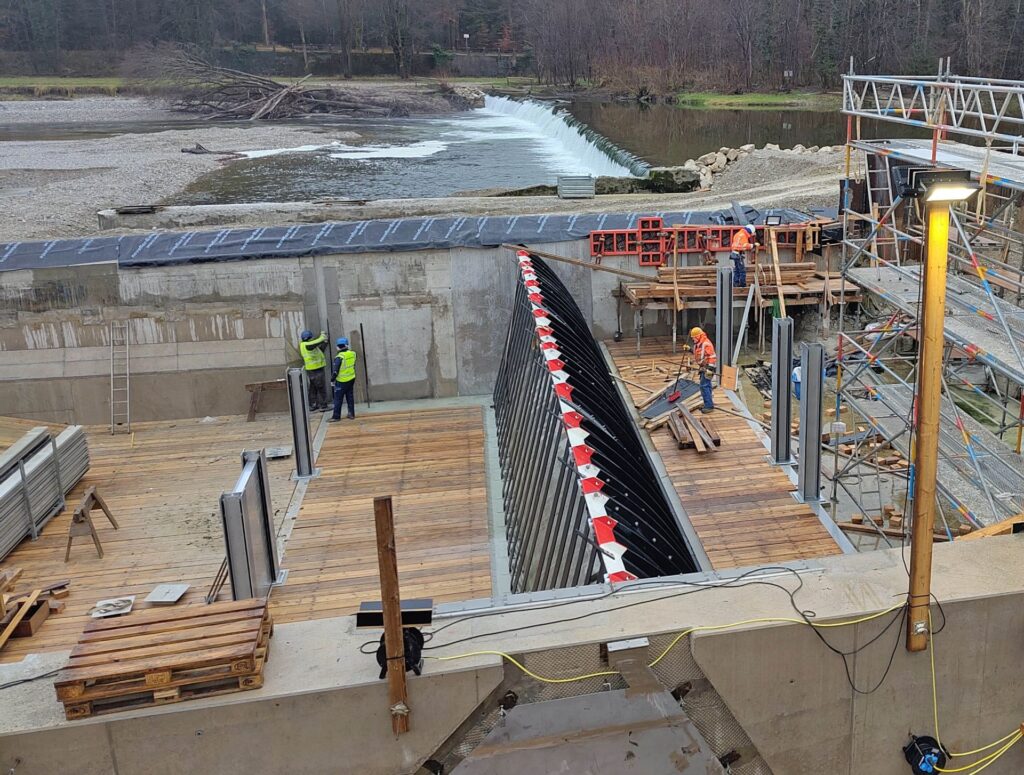
Three systems have now been combined to regulate the water levels at the weir. Level regulation on the left weir section is controlled via a concealed torsion drive steel weir gate installed within the weir pillar. This section is also used to ensure a continuous supply of water to the downstream section. An air-operated flap gate from the renowned American manufacturer Obermeyer Hydro Inc. has been integrated at the second section of the weir. The patented system has proven its worth around the globe, and was supplied by the British industry specialist Dyrhoff UK Ltd. – Obermeyer Hydro’s European distributor. It consists of a combination of robust steel panels raised or lowered by pneumatically operated air bladders. Unlike hydraulically operated flap gates, the pneumatic flap gate is supported across their entire width by inflatable air bladders. Resultantly, foundation work is kept simple, as is efficient and cost-effective flap design. As no intermediate pillars were needed for the system, construction costs were reduced and the available cross-section for flood discharge was increased. Operation purely via pneumatic forces, and no need for lubricants that could contaminate the water, means the system scores highly from an environmental perspective. The third weir section of the facility consists of a fixed weir sill to achieve absolute simplicity of function. The division weir between the Isar and the canal serving the plant has also been completely rebuilt to consist of five sections of weir – each 5.5m wide. The hydraulic engineering equipment for these five weir sections comprises three double gates and two single gates. These are operated by electromechanical drives.
© Pfaffinger
Complex construction phase at the Großhesseloher Weir
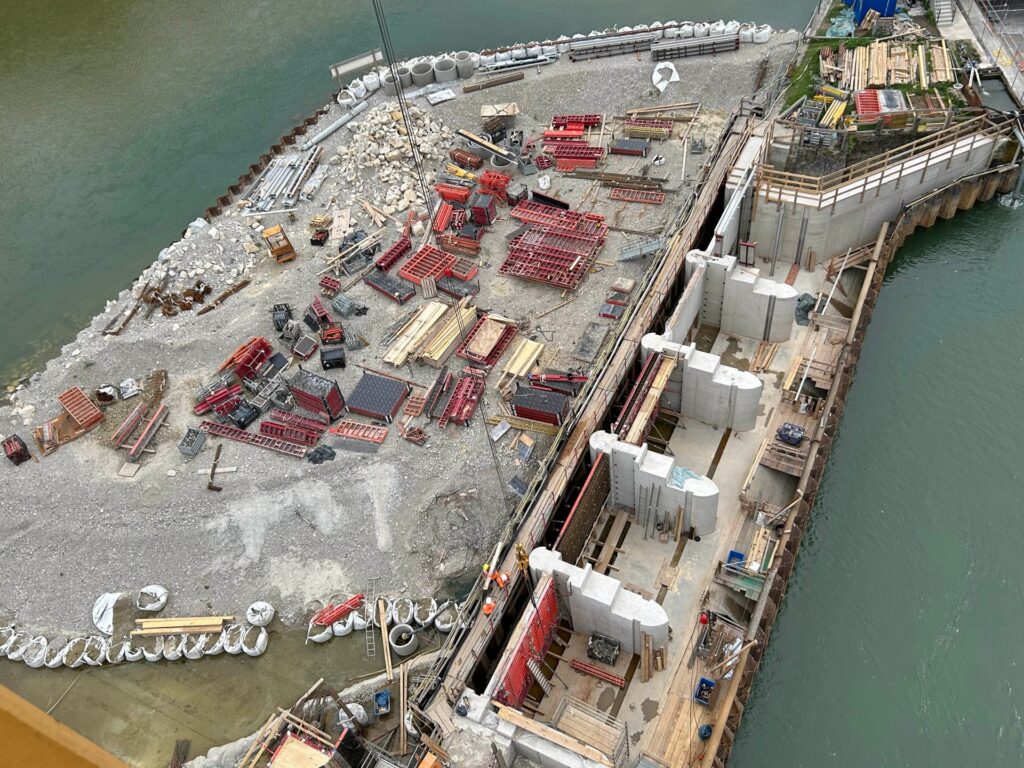
SWM placed its trust in established construction and engineering sector companies for the implementation of refurbishment work. In spring 2021, the hydraulic engineering experts at SWM’s specialist department brought Tractebel Hydroprojekt GmbH on board to carry out the detailed design tasks. Tractebel’s scope of services included structural design production, construction sequencing and phasing, and on-site construction supervision. Following a public tender, the Pfaffinger Group was awarded the contract for all construction work. However, the implementation phase generated a number of challenges and several surprises. According to Pfaffinger, who had between 20 and 25 workers on site during concreting work, one issue had been that storage space was very limited for a construction project of this scale. Around 750 m³ of concrete and approximately 150 tonnes of steel reinforcement were used for concreting for the base slab at the weir. Up to 13 pumps ran simultaneously at a delivery rate of up to 160 m³/h to ensure the construction site remained reasonably dry during concreting procedures. Extreme flexibility was essential throughout the entire construction phase. At the very start of the construction phase it became apparent that the sheet piles required for the dewatering measures could not be driven fully into the ground due to the geological conditions, so it was necessary to include time for approximately 2,000 metres of soil replacement drilling in the construction schedule. Nor was the weather always kind during the approximately 2-year construction phase. Indeed, the excavation pit was flooded on three separate occasions. During demolition work in June 2023, site workers were surprised to discover parts of Munich’s old main synagogue at the bottom of the riverbed. This had been destroyed by the Nazis in 1938. The find attracted international media scrutiny, not least for the many artistically carved stones, and a well-preserved section of the panel shrine. Moreover, there was significant media attention for a series of arson attacks in and around Munich in August 2023, too. The attacks delayed work at the construction site as the perpetrators completely destroyed a crawler crane.
© SWM
Refurbished Großhesseloher Weir improves flood protection and fish migration
Completion of the refurbishment project was scheduled for July 2025, with just a few subsequent loose ends. Although the implementation phase proved to be challenging, the municipal utility providers drew a positive conclusion as regarded the refurbishment project, and emphasised the benefits it now delivers. Functionality has been enhanced for flood situations. The weir structure is designed to be fully passable with a significantly minimised risk of log jams. Ecologically, the fish ladder is the ideal solution considering conditions at the site – optimising passability for aquatic life, and ensuring the ecological connectivity of the Isar and Werkkanal water systems.