
Twin Cross-Flow Turbines in Emmen Generate Electricity from Treated Wastewater
Bild: © ARA Buholz
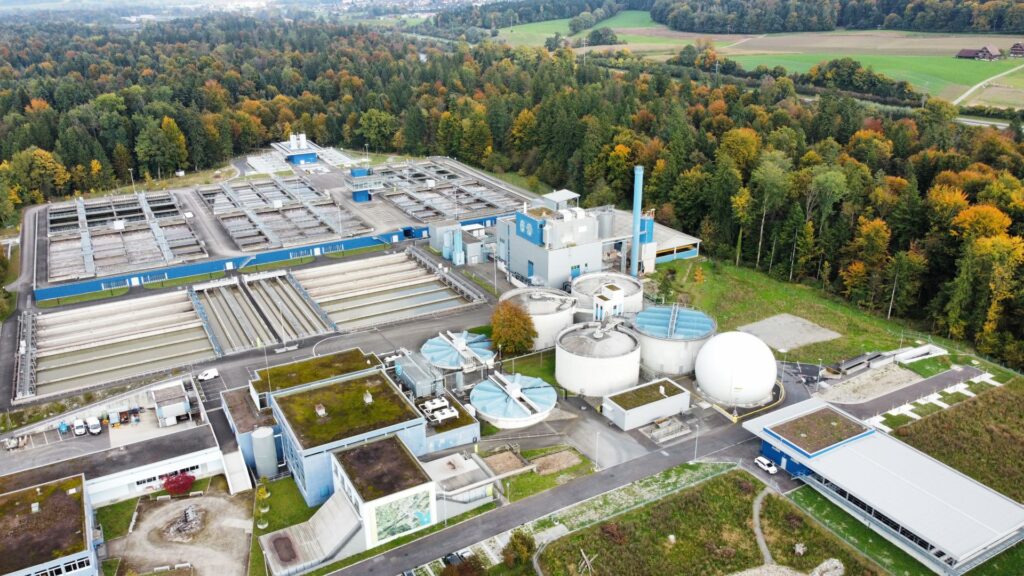
The Buholz wastewater treatment plant in Emmen, Switzerland, has been generating green electricity from the head of its treated wastewater since September 2025. The project involved the installation of two identical 42-kW Ossberger cross-flow turbines, whose robust design and durable technology are now proving their worth in operation on site. Working together at the new treatment stage of the largest wastewater treatment plant in the canton of Lucerne, the two turbines supply enough electricity to serve approximately one quarter of the plant’s total power requirements.
© ARA Buholz
Wastewater Treatment Plant Expands with Hydropower Generation
At the start of 2016 an amendment was made to the Swiss Water Protection Act. This required large wastewater treatment plants to install a special system for the removal of trace substances. This is referred to as the fourth stage of treatment in which micro-contaminants – such as residues from medicines, cosmetics or pesticides – are filtered out of the water. The amendment also affected the Buholz wastewater treatment plant (WWTP) in Emmen, owned by REAL (Recycling Entsorgung Abwasser Luzern), the Lucerne municipal association for recycling, waste disposal, and wastewater in the Swiss canton of the same name. Buholz has what is considered to be the largest wastewater treatment plant in Central Switzerland, and hence plays a key role in wastewater treatment within the Lucerne region. The Buholz WWTP treats wastewater for ten towns in the Lucerne conurbation, serving a catchment area of 200,000 residents, plus approximately 50,000 population value equivalents in industry and commerce. The fourth treatment stage expansion project at the Buholz WWTP was implemented between August 2023 and June 2025.
© Ossberger
Cross-Flow Turbines Deliver Reliable Hydropower from Wastewater
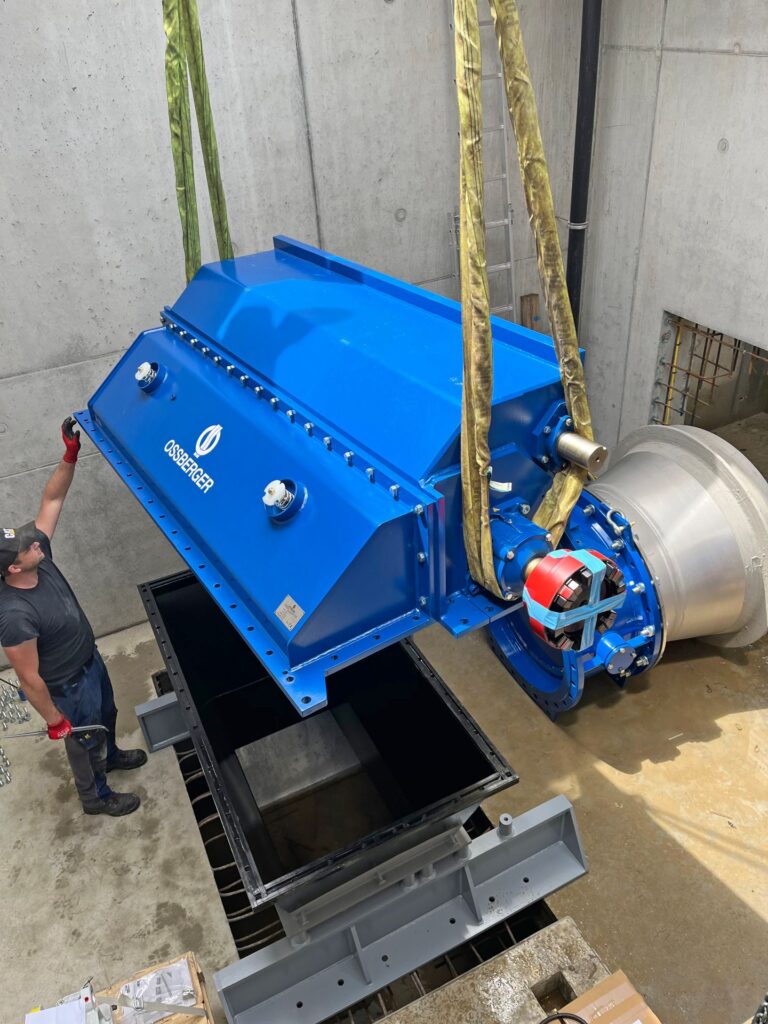
“While the new treatment stage was being built, plans were also being implemented to harness the water for hydroelectric power. After treatment the water descends from a net head of 4 metres to enter the Reuss collection watercourse,” explains Alexander Kleiner of REAL. The potential is harvested via two identical cross-flow turbines made by Ossberger – the long-established German hydropower company from Bavaria. These were installed in parallel in the two treatment plant outlet basins. Obviously, the operators opted for Ossberger’s tried-and-tested cross-flow technology, the Bavarian specialists’ solution being known for its robustness, and exceedingly broad scope of applications. An Ossberger cross-flow turbine has only three moving parts – a testament to design simplicity, and ultimately a reason for its superior reliability. Moreover, thanks to the turbine solution’s two-cell interior design, each cell being able to operate independently of the other, it is also ideally suited to generating electricity – even at the lowest water levels. This is a further compelling argument for the use of cross-flow turbines at a wastewater treatment plant, where water volumes are subject to considerable fluctuations.
Automated Turbine Control Maximises Energy Recovery
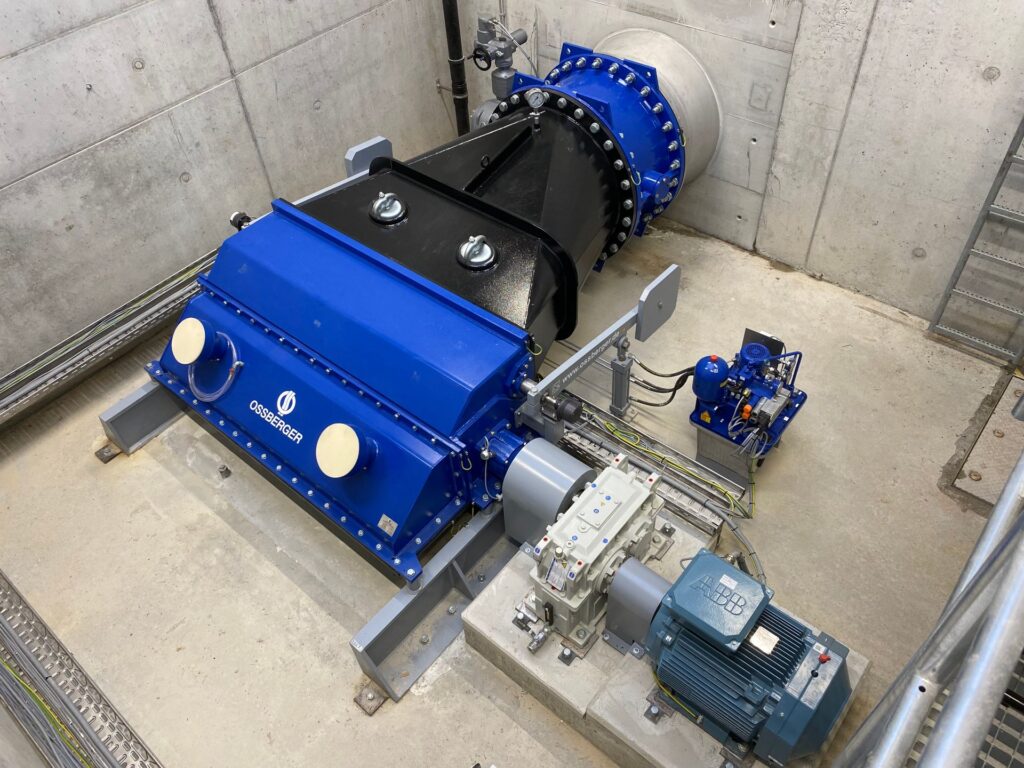
Outlining the basic principle Christian Habermann, Technical Manager at Ossberger, explains: “Essentially, the design of the two turbines features an inlet pipe for each unit, integrated into the outlet of each respective tailrace, with a butterfly valve flanged onto the pipe. The drive water is then channelled into the turbine via a conduit pipe.” He then goes into more detail: “There’s a water level sensor in the outlet basin. It’s in continuous operation, and the signal it generates directs the turbine’s guide vane. This opens, closes and adjusts its position according to the water level, and thereby regulates the flow rate automatically to ensure the water level is stabilised at a specified point and maintained at a constant level.” Each of Ossberger’s two turbines is designed for a net head of 4m and a flow rate of 1,313 l/s. The 1:6.733-ratio gearbox modulates specific turbine rpm, to harmonise with the generator’s nominal speed of 1,010 rpm. Ultimately, the generator converts this mechanical energy into electrical power. Each of Buholz’s Ossberger cross-flow turbines at the wastewater treatment plant has a nominal output of 42kW. The Bavarian hydro- power specialist’s scope of delivery encompassed the complete electromechanical system, the turbine and regulator, the control system and feed-in, gearbox and generator, shut-off valve, installation and commissioning. The turbine control system was integrated into the higher-level control centre, ensuring comprehensive centralised control.
© ARA Buholz
Hydropower Covers Around 25 Percent of the Plant’s Electricity Demand
Commissioning of the turbines was completed in September 2025, immediately following official commissioning of the new treatment stage. Alexander Kleiner, Head of the Wastewater Division at REAL, described the first few weeks of operation very positively: “Our experience so far has been very good. The turbines have been running smoothly, and there have been almost no disruptions. They currently supply about a quarter of the electricity required for the new treatment stage.”
Now the Buholz wastewater treatment plant project has been completed, it is providing impressive proof that, even at unusual locations such as a wastewater treatment plant, green hydroelectric power can be generated effectively. This re-quires a certain degree of open-mindedness, but also – ob-
viously – the use of technology suited to the task. The robustness and reliability of Ossberger’s cross-flow turbines make them ideal for the job. This has not only been underlined by success at the Buholz wastewater treatment plant, as Ossberger Regional Sales Manager Markus Sauerbeck em-phasises: “Ossberger has been active and successful in energy generation at sewage treatment plants for many years, having equipped numerous such plants and water treatment facilities with our reliable and durable turbine sets. The cross-flow turbine has shown itself to be an efficient and robust solution in this field of application.” The Bavarian hydropower specialists are active in this sector around the globe, and plan to work on further projects of this kind.