
Revitalised Blautopf Hydropower Plant Generates Green Electricity for Drinking Water Supply
Bild: © Electro Clara
In 2024, work began on the redevelopment of the Blautopf site – one of the main attractions in Blaubeuren, a small town in the Alb-Donau district in Germany. The small hydroelectric power station on the site had been out of operation for decades. By the summer of 2025 it had been completely refurbished. Since this time, the modernised power station has been generating clean energy again. The energy is used at the site itself to power the Blautopf drinking water pump station. As a trusted South Tyrolean company specialising in hydro-industry solutions, Wild Metal GmbH was chosen to supply the entirety of the steel hydraulic engineering equipment required to refurbish the power station and weir system. The electrical and control systems were provided by Electro Clara, an automation specialist also based in South Tyrol.
© Wikimedia/BPA
Blautopf Restoration Combines Heritage Preservation and Hydropower
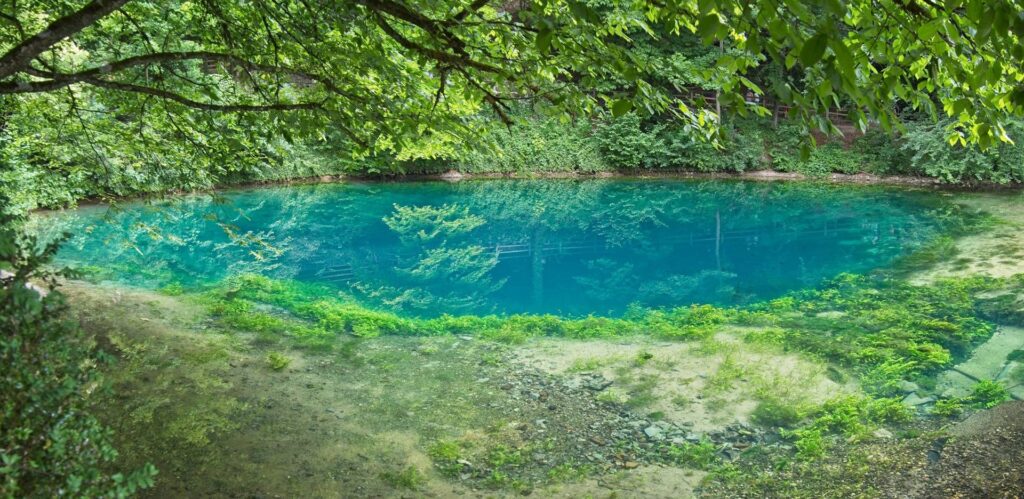
Blautopf weir is a veritable tourist magnet on the edge of the old town of Blaubeuren. A natural karst spring feeds the eponymous blue pot (Blautopf) dam, and the water shimmers in various intense shades of blue depending on the time of day and the angle of the light. Every year up to 500,000 visitors are attracted to a site that also houses the historic hammer mill. A comprehensive revitalisation project was launched in 2024 for the outdated structural and technical infrastructure in the surroundings at the landmark in this small town in Baden-Württemberg. Renovation and modernisation measures aim to preserve existing structures – some of which are listed; and to enhance the area’s appeal. Furthermore, renovation work is also addressing practical aspects, not least accessibility and safety.
© Wassermüller
Blautopf Restoration Combines Hydropower and Water Supply
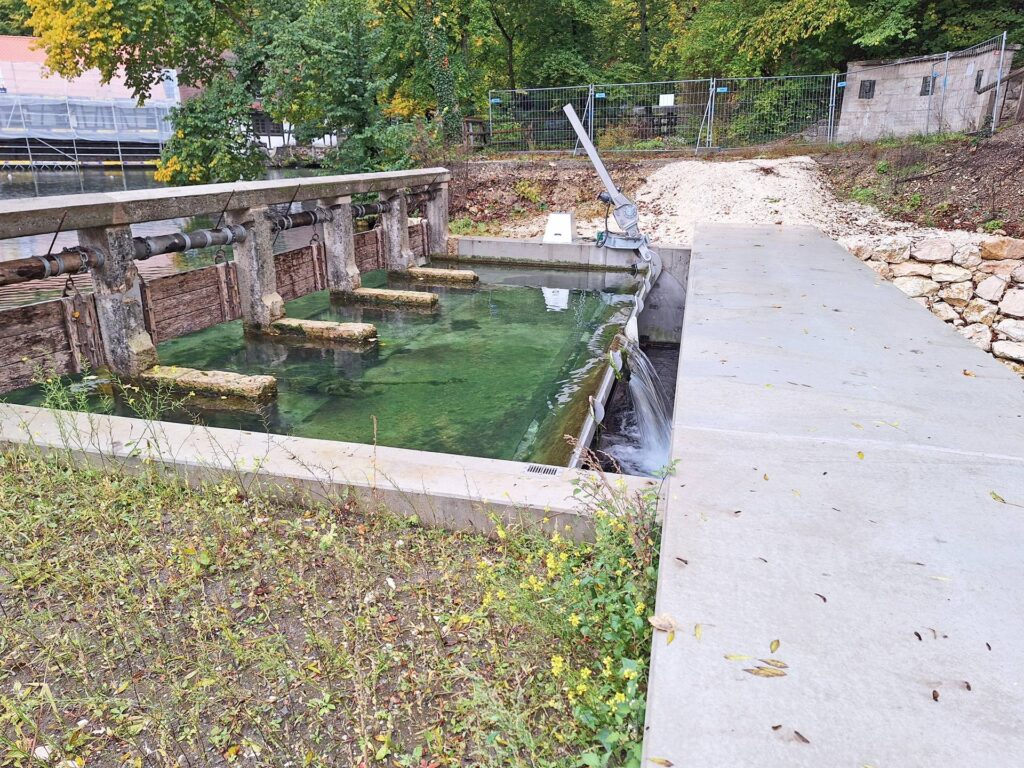
An important milestone for the Blautopf restoration project was reached in the summer of 2025 as the new weir system was completed, also facilitating barrier-free access around the site. The weir system forms part of the infrastructure at the reactivated small-scale hydroelectric power station, but had been out of operation for almost 30 years due to technical faults. The engineering company Wassermüller in Ulm planned the weir and power station refurbishment, and project manager Andreas Kramer explained the advantages: “An association especially established for the purpose – Albwasserversorgungsgruppe III – has a pumping station at the Blautopf weir and is now benefitting from the recommissioning of this hydroelectric power station. Every day in 2024 the system transported an average of over 1,122 m³ of water to the plateau of the Swabian Alb. The association can now use electricity generated by the power station to meet the pumping station’s own energy requirements.” Wassermüller is continuing redevelopment work at the Blautopf weir in collaboration with eight other engineering firms and specialist planners.
© Electro Clara
Protected Landmark Presents Complex Challenges
Andreas Kramer tells of several challenges posed by the renovation projects. Classified as a site of the highest ecological importance, the Blautopf enjoys protected status. Consequently, the project was subject to a whole range of environmental protection requirements and the listed site’s preservation was a high priority. Geologically speaking, the nature of the ground conditions necessitated complex drainage measures. These challenges were compounded by protests by restaurant owners and businesses who, for obvious commercial reasons, insisted the site be opened to visitors during renovation. Ultimately, the protestors were assuaged by allowing limited access to the site. Although visitors and business owners were pleased by this partial opening, it hampered the execution of construction work. As project manager Kramer noted, considerable effort was expended on the restoration of the old weir – a listed structure. “We worked with a heritage conservation specialist who mapped and documented every stone when we dismantled and reconstructed the historic weir. The old weir blocks were dismantled, stored temporarily, and put back in place piece by piece during reconstruction.”
© Wild Metal
South Tyrolean Steel Hydraulic Engineering for Blautopf
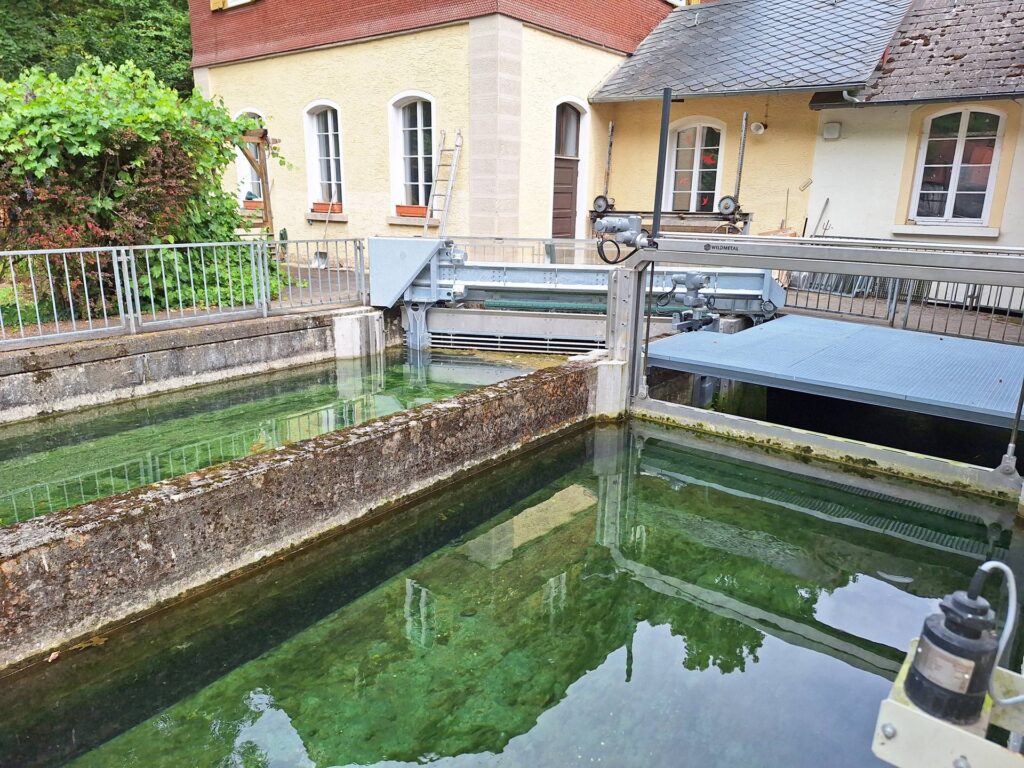
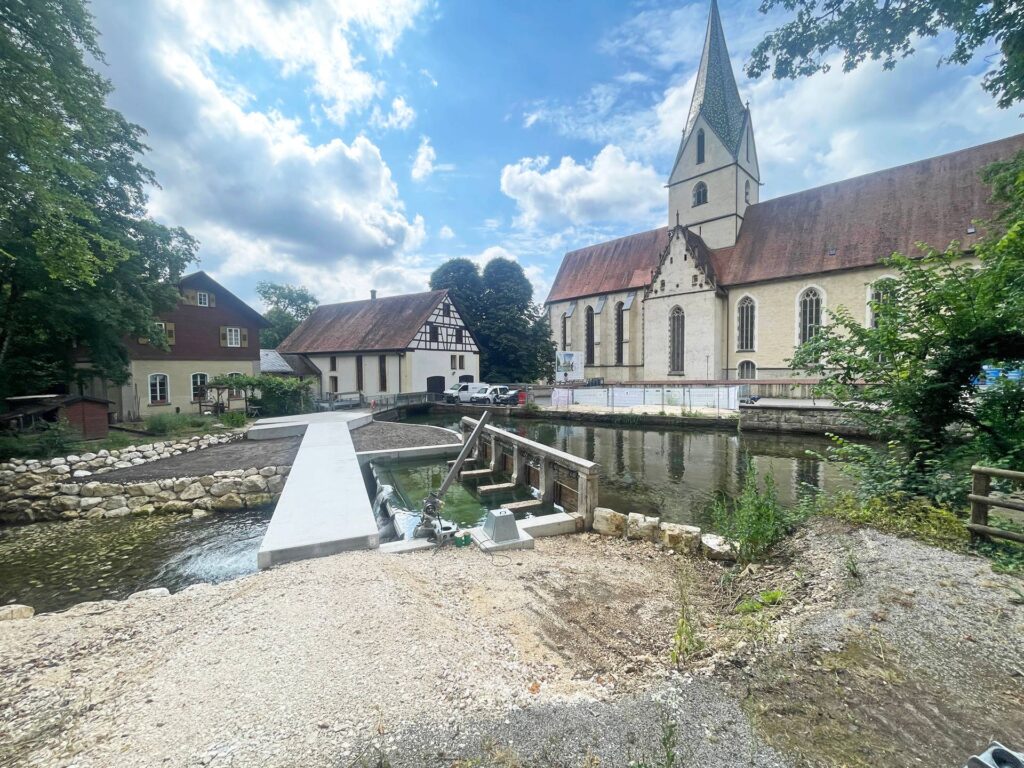
The new Blautopf weir set-up was installed directly in front of the old weir, the listed historic structure being a key feature following its restoration. All steel hydraulic engineering equipment was supplied and installed by Wild Metal GmbH – the renowned South Tyrolean company. “To ensure the Blautopf water was not contaminated in the event of damage, the movable steel hydraulic engineering components were fitted without hydraulic drives, instead relying purely on electromechanical drive systems. “When designing the steel hydraulic engineering components, great importance was attached to unobtrusive and harmonious aesthetics, in line with the customer’s wishes,” stated Wild Metal technician Daniel Polig. The largest component in Wild Metal’s scope of delivery was the 9.5-metre width weir gate, with the opening for residual water discharge being installed in a central position. The gate actuator was mounted on the left-hand side of the weir and fitted with a flood float to trigger emergency weir gate opening at a specific water level. The South Tyroleans supplied a protective trash rack for the power station intake – approximately 4.1 m wide and 1.1 m high with horizontal bars – as well as the accompanying rack cleaning machine, and its housing. The water level-adapted trash rack cleaner guarantees optimal intake flow. Debris removed from the rack is conveyed to a rotary gate by the cleaning rake, and discharged under the waterline below. Wild Metal’s scope of delivery was rounded off with a dam beam closure and an additional shut-off gate.
© Wassermüller
Historic Francis Turbine Returns to Service
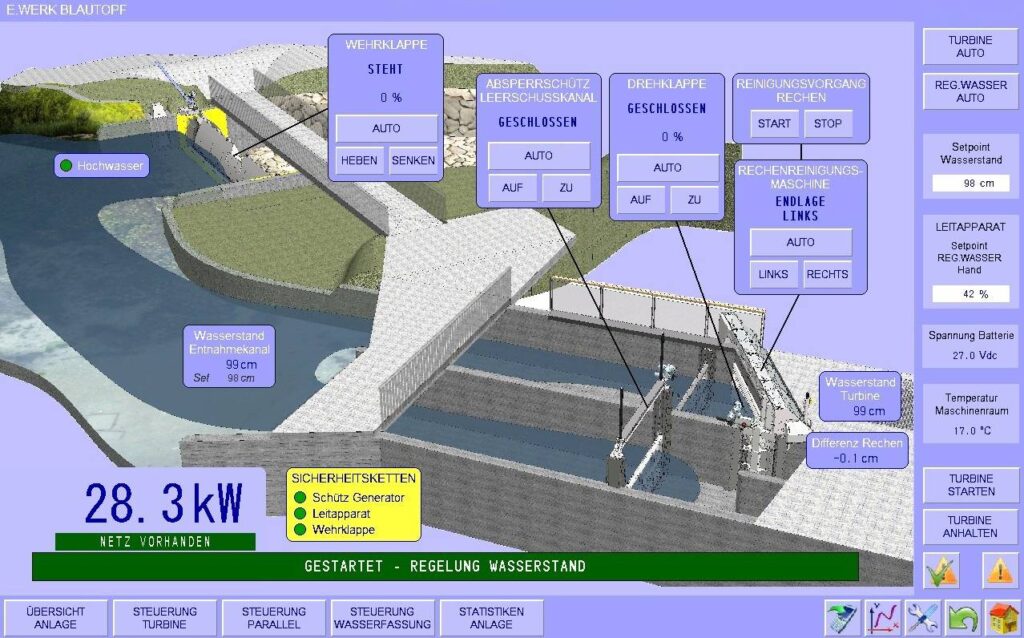
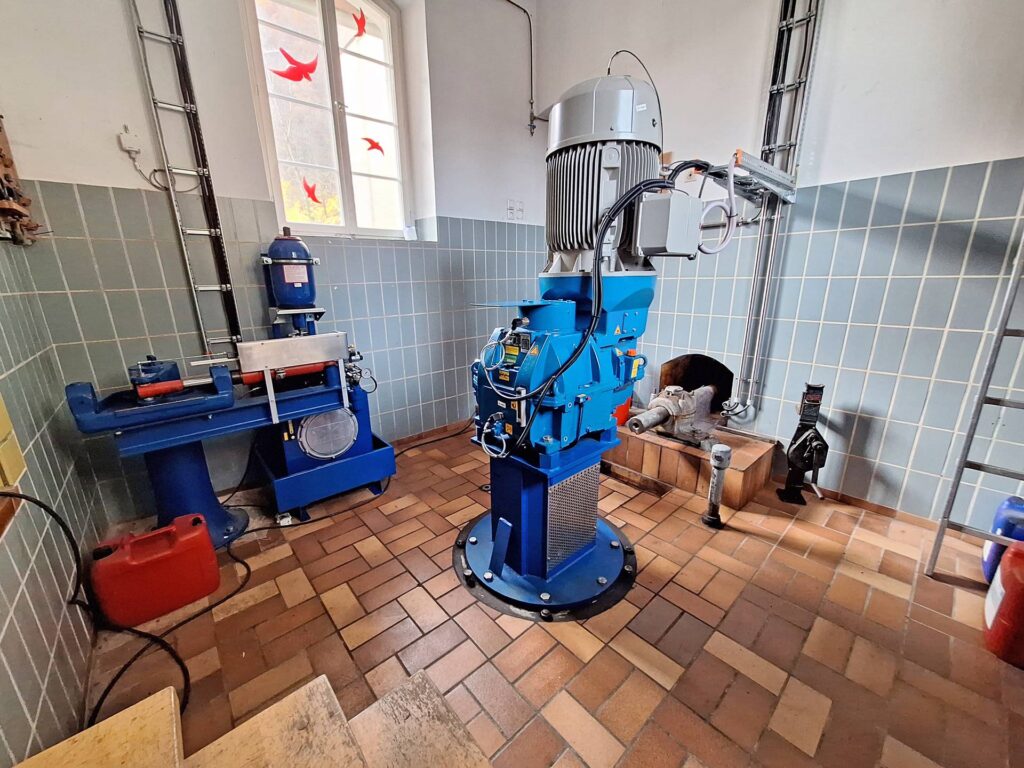
The existing equipment in the machine room at the small power station has been thoroughly modernised and replaced. Having been severely damaged and out of service for almost three decades, the vertical-axis Francis turbine required comprehensive refurbishment. Installed in 1962, the turbine had been designed for a maximum flow of 1,820 l/s and a head of 2 m. Prior to decommissioning, the turbine had served as a mechanical drive for a double-piston drinking water pump. The turbine was fitted with a new gearbox and a new asynchronous generator during electromechanical modernisation work in the powerhouse. The association’s drinking water pumping station is supplied with clean electricity by what is essentially a new machine; one capable of achieving a peak output of 37 kW at full water supply volume. Another South Tyrolean company, Electro Clara, subcontracted to Wild Metal, was responsible for the provision and installation of all electrical and control engineering components. These automation specialists supplied the entire array of control equipment for the hydroelectric power station, and for the steel hydraulic engineering components. The power station control system, visualised for user-friendliness, was also programmed by Electro Clara, and now facilitates fully automatic plant operation. The control system can be accessed either via a touchscreen display in the machine building, or via online connectivity with a variety of devices such as PCs, tablets or smartphones.
© Electro Clara
Blautopf Revitalisation Continues until 2028
Refurbishment of the weir and revitalisation of the small hydroelectric power station were completed in the summer of 2025, so since the beginning of July the energy generated at the plant has been clean, green energy again. Andreas Kramer recounts how the project was both exciting and challenging: “Although implementation wasn’t always straightforward, the professional collaboration of every company involved ensured the various refurbishment and renovation measures were completed successfully. It’s very satisfying to know that, although the power station had remained unused for a long time, the infrastructure has now been restored. The energetic synergy between the hydroelectric power station and pumping station has definitely been a success.” Completion of refurbishment activity for the Blautopf site is scheduled for 2028, and Andreas Kramer is confident it will be a success. “There’s nervous excitement, but working as a team – we’ll get it done.”